
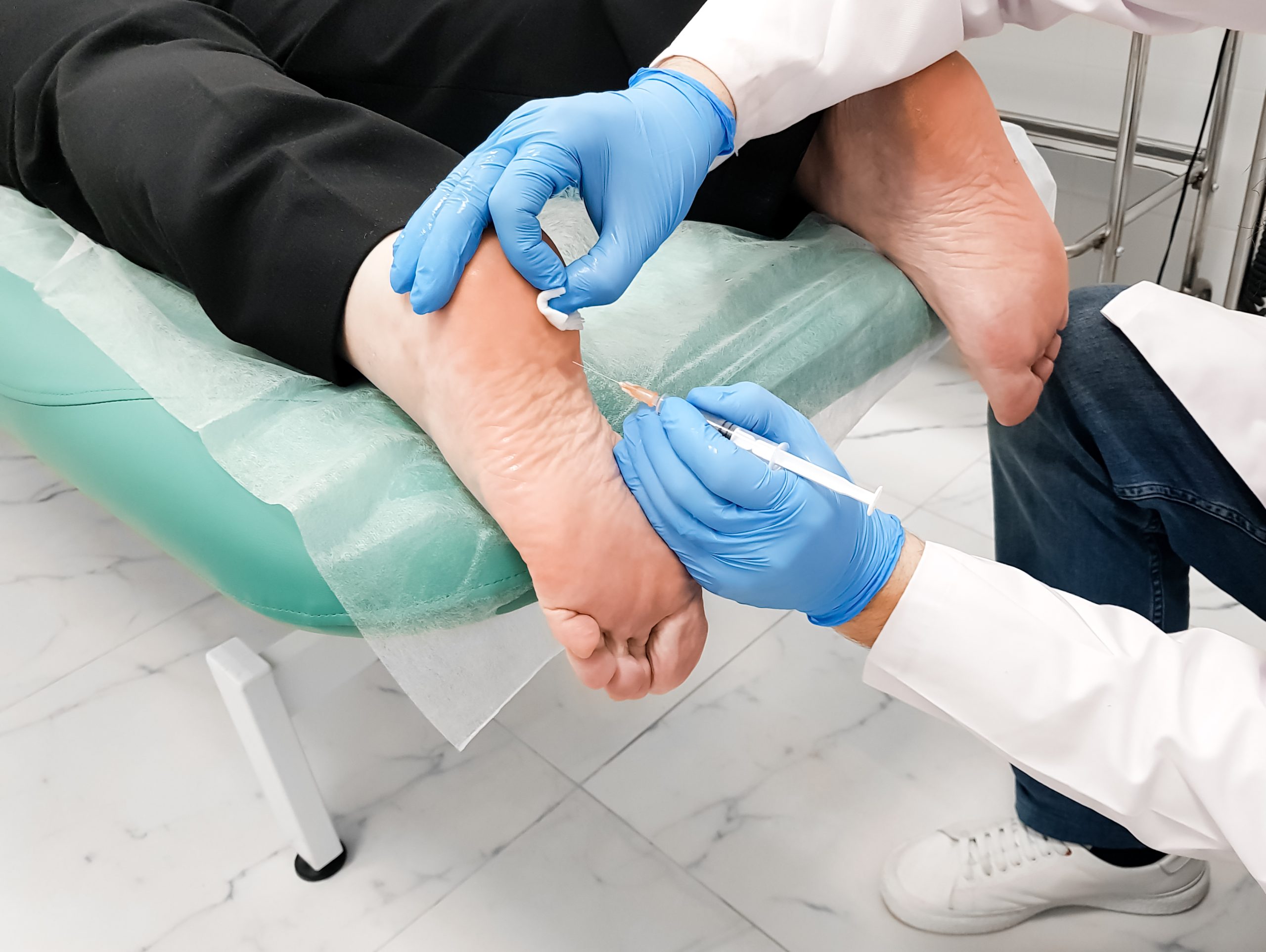
You did the reasonable thing. You had heel pain that would not settle down, you saw a provider, and you got an injection. Maybe it helped for three weeks and then faded. Maybe it barely helped at all. Either way, you are back where you started and wondering whether anyone actually knows what is wrong with your foot.
That frustration is fair. But if your cortisone shot did not work for your heel pain, this is a common and informative result, not a dead end and not a sign that you were treated badly. A steroid injection is a legitimate step. It addresses one specific mechanism, and in longstanding heel pain that mechanism is often no longer what is driving your symptoms.
Here is what that result usually means, and what the realistic options are from here.
Table of Contents
- What a Cortisone Shot Actually Does
- Four Reasons Heel Pain Persists After a Steroid Injection
- A Note on Repeat Injections
- Alternatives to Cortisone: What Comes Next
- What Nobody Can Promise You
- Heel Pain in Alexandria and the Northern Virginia Corridor
- When to Be Seen Sooner Rather Than Later
- Frequently Asked Questions
- Bring Your History and Get a Straight Answer
What a Cortisone Shot Actually Does
Cortisone is a powerful anti-inflammatory. When it is injected near the plantar fascia, the thick band of tissue running along the bottom of your foot from your heel to the base of your toes, it works by calming inflammation in and around that tissue.
That works well when inflammation is genuinely the problem. Early on, it often is.
The wrinkle is that heel pain lasting more than a few months frequently is not an inflammatory problem anymore. Tissue from long-standing cases tends to show degeneration rather than active inflammation: disorganized collagen, small areas of breakdown, and new blood vessel growth. The tissue is not inflamed so much as it is failing to repair itself.
An anti-inflammatory injection has very little to grip onto in that situation. So a short-lived response or no response is not a mystery. It is information, and it points toward a different category of treatment.
Four Reasons Heel Pain Persists After a Steroid Injection
- The tissue is degenerative, not inflamed. This is the most common explanation, and it is the one that points toward the options further down this page.
- The diagnosis may not be what everyone assumed. Not all heel pain comes from the plantar fascia. A nerve branch on the inner side of the heel can become irritated and produce burning or radiating pain. A stress reaction in the heel bone often hurts on squeezing the sides of the heel rather than underneath it. Thinning of the natural fat pad produces a deep bruised ache that worsens on hard floors. Insertional Achilles problems, tarsal tunnel irritation, and inflammatory arthritis all put pain in the same neighborhood. A steroid injection aimed at the fascia will not do much for any of these.
- The mechanical driver was never addressed. Tight calves that limit ankle motion, a jump in mileage or standing hours, worn-out shoes, or a job on hard flooring all keep loading the same tissue. An injection quiets the alarm. It does not change the load setting it off.
- There was no structured loading program alongside it. Degenerative fascia and tendon tissue responds to progressive, deliberate loading. Rest alone rarely resolves it, and neither does an injection on its own.
A Note on Repeat Injections
Some people do reasonably well with a second injection, and it is worth discussing. But repeated steroid injections into the same heel carry documented risks, including thinning of the protective fat pad and, less commonly, rupture of the plantar fascia. That does not make a second shot wrong. It does mean the conversation should cover how many you have had, how long each lasted, and what the plan is if this one also fades. If the honest answer is “another shot and see,” it is reasonable to ask what else is on the menu.
Alternatives to Cortisone: What Comes Next
Start with a real re-examination
Before adding another treatment, the diagnosis deserves a second look: a hands-on exam that locates exactly where the pain sits, checks calf flexibility and ankle motion, tests the nerve branches, and considers imaging. X-ray can rule out bone causes. Diagnostic ultrasound can show fascia thickness and tissue quality. Ask directly what imaging the office can do and what it will cost you.
Fix the load before you buy anything expensive
A lot of people improve with a boring plan executed consistently: a daily calf and fascia loading routine, footwear with real structure, activity modification for a defined stretch of weeks, and taping or a night splint if morning pain is the worst part. These are inexpensive and worth a genuine trial before moving up the ladder.
On orthotics, ask whether an over-the-counter insert is a reasonable first test for your foot. Custom devices help some people considerably, but they can carry significant out-of-pocket cost depending on your plan, and they are not the right first purchase for everyone. A provider willing to tell you that is worth keeping.
Radial shockwave therapy
Radial shockwave delivers pulses of acoustic energy through the skin into the painful tissue. The goal is different from cortisone: rather than suppressing inflammation, it aims to provoke a healing response in tissue that has stalled, by increasing local blood flow and stimulating cellular repair activity.
Practical details matter here. It is done in the office over a series of sessions spaced roughly a week apart, without anesthesia or downtime, and most people drive themselves home. Coverage varies widely and many plans treat it as non-covered, so ask for the total cost of a full course before you start, not the per-session price. More on our radial shockwave therapy page.
Platelet-rich plasma (PRP)
PRP starts with a small blood draw from your arm. The sample is spun in a centrifuge to concentrate the platelets, which carry growth factors involved in tissue repair, and that concentrate is injected into the target tissue, usually with ultrasound guidance for accuracy.
The reasoning is the same as shockwave: target the repair problem rather than the inflammation. The published evidence for PRP in chronic heel pain is still developing and results vary between people and between studies, which is worth saying plainly. Unlike cortisone, PRP often causes a few days of increased soreness before any improvement, and it is commonly an out-of-pocket expense. If you have had a steroid injection recently, that can affect when PRP is appropriate, so bring the date of your last shot. More detail is on our PRP therapy page.
Surgery
Surgical options exist for the small share of cases that do not respond to a well-executed non-surgical plan over enough time. It is a later conversation, not an early one.
What Nobody Can Promise You
No provider can tell you in advance that shockwave or PRP will resolve your pain. Anyone who does is overselling. What a good visit can give you is a clearer diagnosis, an honest read on which mechanism is driving your symptoms, the real cost of each option before you commit, and a defined point at which you reassess instead of drifting.
If you want the fuller picture of why heel pain starts and what first-line care looks like, our article on crippling heel pain in Arlington, VA covers that ground.
Heel Pain in Alexandria and the Northern Virginia Corridor
Where you live and work shapes this problem more than most people expect. Old Town’s brick and cobbled sidewalks are unforgiving under a heel that has lost fat pad cushioning. Plenty of our patients walk a hard half mile from the King Street or Eisenhower Avenue Metro twice a day in dress shoes, a real daily load that never shows up in anyone’s exercise log. Runners on the Mount Vernon Trail and Four Mile Run path put in long flat mileage on packed surfaces, and spring mileage jumps are a reliable trigger. Federal and contractor staff around Mark Center spend the day on tile and concrete.
None of that changes the biology. It changes the plan, because a treatment that ignores what your feet do between 8 a.m. and 6 p.m. tends not to hold.
Our office is on Eisenhower Avenue in Alexandria with parking on site, and we see patients from Del Ray, Old Town, Kingstowne, Arlington, Springfield, and across Fairfax County.
When to Be Seen Sooner Rather Than Later
Come in promptly, or seek urgent care, if you have any of the following:
- A sudden pop in the heel or arch followed by swelling or bruising
- Inability to put weight on the foot
- Numbness, burning, or tingling spreading into the foot or toes
- Pain that wakes you at night or is present at rest
- Fever, redness, or warmth around the heel
- Diabetes or neuropathy along with any break in the skin on the foot
Frequently Asked Questions About Cortisone Shots for Heel Pain
How long should a cortisone shot last for heel pain?
Responses vary a lot. Some people get several months of relief, others get a few weeks, and some notice very little change. A short-lived response often suggests the tissue problem is degenerative rather than inflammatory, which points toward treatments aimed at tissue repair instead of inflammation control. Track how long yours lasted and share that number at your next visit.
Can I get a second cortisone injection in my heel?
Sometimes, and it is a reasonable discussion to have. Repeated steroid injections into the same heel carry documented risks, including thinning of the heel’s protective fat pad and, less commonly, rupture of the plantar fascia. If you are considering another one, ask how many you have had, how long each lasted, and what the plan will be if this one also fades.
Is shockwave therapy better than cortisone for heel pain?
They work differently rather than one being universally better. Cortisone suppresses inflammation and can act quickly. Radial shockwave aims to stimulate a repair response in tissue that has stopped healing, which is why it is often considered after an injection has not held. Results vary by person, and neither approach can be guaranteed in advance.
Does insurance cover shockwave therapy or PRP for heel pain?
Coverage varies widely by insurer and plan, and both are frequently treated as non-covered or partially covered. Ask for the total cost of a full course before starting rather than the per-session figure, and ask whether the office can verify your specific benefits first. Getting that answer in writing prevents the most common billing surprise.
How long after a cortisone shot can I have PRP?
Timing depends on when your last injection was given and how your tissue responded, so it is decided case by case. Bring the date of your most recent steroid injection to your appointment. That single detail affects sequencing more than almost anything else you can tell us at a first visit.
Bring Your History and Get a Straight Answer
If your heel pain came back after an injection, bring the details: when the shot was given, how much relief you got, how long it lasted, and what else you have tried. That history narrows the diagnosis faster than starting from zero.
Request a heel pain re-evaluation at our Alexandria office. We will examine the foot properly, tell you which mechanism we think is driving your pain, walk you through what each option costs, and give you a plan with a defined checkpoint.
Written by the clinical team at District Foot & Ankle, Alexandria, VA.
This article is general education and is not a substitute for an in-person evaluation. Heel pain has multiple possible causes and treatment decisions depend on individual examination findings. Individual results vary and no outcome is guaranteed.