

Minimally invasive bunion surgery (MIS) is a modern approach to correcting hallux valgus (bunion) deformities using small incisions, specialized instruments, and advanced imaging techniques.
Before getting into minimally invasive bunion surgery, let’s do a quick recap on what exactly a bunion is and the evolution of bunion surgery.
What is a bunion?
A bunion is a bony bump that forms on the joint at the base of your big toe. It results from a misalignment of the bones in the foot, often causing the big toe to angle toward the second toe.
With bunions becoming more prevalent, ways to treat them have also evolved, with surgery being done on more painful and severe cases.
Evolution of bunion surgery
In the early 20th century, Initial attempts were rudimentary and often involved removing part of the metatarsal head (called exostectomy), which reduced the bump but did not correct the deformity. These early surgeries had high recurrence rates and poor functional outcomes.
In the mid-20th century, structural realignment began as surgeons began to understand the biomechanics of bunions. Introduction of osteotomy techniques (cutting and realigning bone), such as:
- Chevron osteotomy (mild deformities)
- Scarf osteotomy (moderate deformities)
- Ludlo, Akin, and base wedge osteotomies
- Introduction of Lapidus procedure (fusion of the first tarsometatarsal joint) for severe or unstable deformities
- Use of internal fixation (screws, pins) improved stability and healing


In the late 20th century, soft tissue procedures began to be incorporated with bony procedures, with soft tissue balancing and capsular repair becoming standard to prevent recurrence. There was a greater focus on:
- Weight-bearing alignment
- Postoperative rehabilitation
- Prevention of overcorrection (hallux varus)
As surgical techniques in general would advance, so would techniques in bunion surgery. In the early 21st century, minimally invasive bunion techniques would begin to emerge particularly in Europe. As of today, MIS bunion surgery is more prevalent in the USA that it has ever been.
What is Minimally Invasive Bunion Surgery?
Minimally invasive bunion surgery aims to correct the bunion through small incisions, rather than large
open cuts. The procedure is done using fluoroscopy (live X-ray) to guide precise bone cuts and fixation.
- Small Incisions (2–5 mm) are made near the bunion.
- A high-speed burr is used to make precise bone cuts (osteotomies).
- The toe is realigned by shifting the bone into proper position.
- The correction is stabilized with tiny screws, inserted through the skin.
- The incisions are closed with minimal stitching or sometimes just bandages.
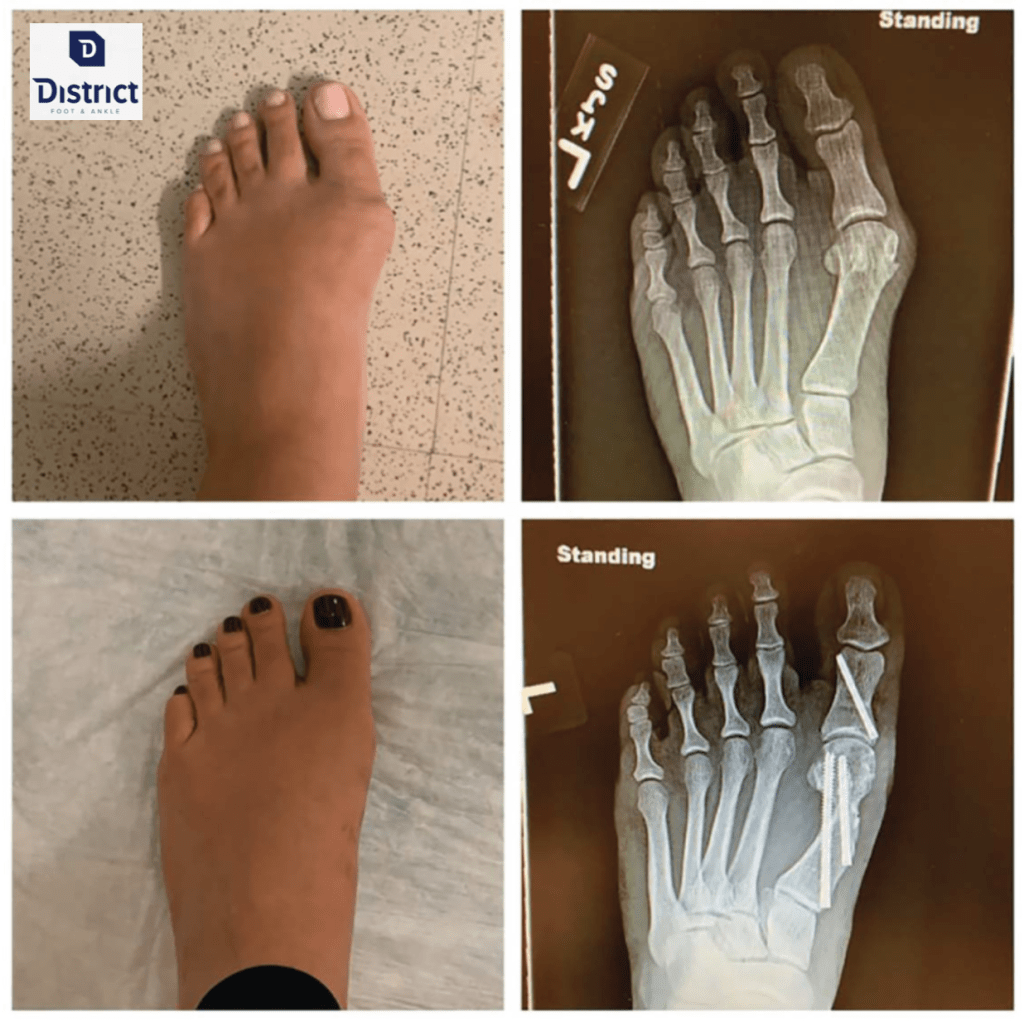
Comparison of MIS vs traditional bunion surgery

Who is a good candidate?
- You have mild to moderate bunion deformity
- You want minimal downtime
- You don’t have severe arthritis or other foot deformities
- You’re generally healthy and a non-smoker (improves healing)
While MIS has many benefits, potential risks include:
- Nerve injury
- Incomplete correction or recurrence
- Overcorrection (hallux varus)
- Screw migration or need for revision
- Inadequate imaging guidance can lead to errors
MIS surgery not just MIS bunion surgery is becoming more and more popular. Choosing an experienced surgeon who specializes in MIS is critical for success as there is a learning curve with using MIS techniques vs more traditional open techniques
Come see us at District Foot & Ankle for a proper evaluation and diagnosis so we can get you back to being a better you today!