

If you have been putting off a foot problem because you have no idea what it will cost, you are not being unreasonable. Podiatrist cost is one of the hardest numbers to pin down before you walk in the door, and many practices do not publish prices at all. That leaves you guessing somewhere between “probably a copay” and “possibly a bill that ruins the month.”
Here is an honest explanation of how podiatry pricing works, what moves it up or down, and why any office that quotes you a firm final number over the phone is telling you something it cannot know yet.
Why Nobody Can Quote You a Final Price Before an Exam
This is the part that sounds like a dodge, and it is not.
When you call about heel pain, the person on the phone does not yet know whether you have plantar fasciitis, a stress fracture, a nerve problem, or a tendon problem. Those are four different workups. One might be a single visit and a stretching program. Another might need imaging on the first visit and a follow-up plan over several weeks.
A price quoted before an exam is a guess dressed up as a commitment, and when the real bill arrives higher, patients reasonably feel misled. We would rather explain what the cost is built from, publish self-pay prices for common services, and give you the real number in the room once we know what we are treating.
What we can show you before you book is our cash-pay prices page. It is a partial list, not the full fee schedule, and the page itself notes that final out-of-pocket costs cannot be determined before a physician examines you. Your podiatrist may also recommend services that are not on it. But it is real, it is public, and you can read it before you decide.
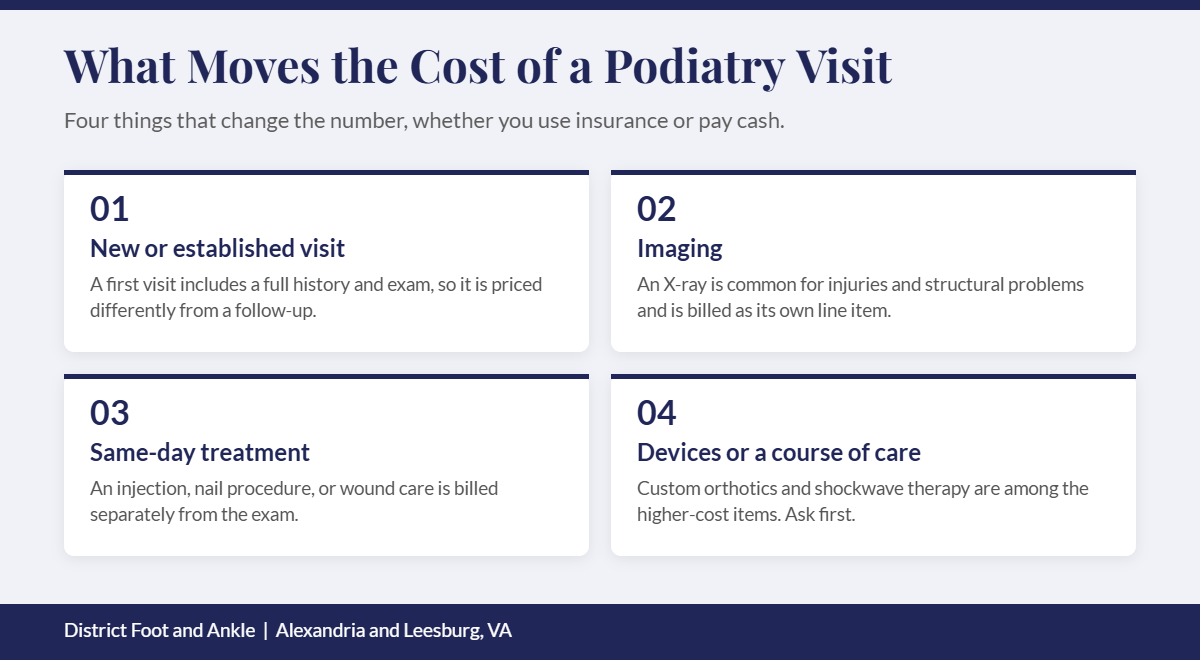
The Four Things That Actually Move the Number
1. Whether the Visit Is New or Established
A first visit includes a full history and exam and takes longer than a check-in on something already being managed. New patient and follow-up visits are priced differently almost everywhere. At the time of writing, our cash-pay prices page lists a new patient examination at $300.00 to $450.00 and a follow-up examination at $200.00 to $250.00.
2. Whether You Need Imaging
An X-ray on the first visit is common for injuries, suspected fractures, and structural problems such as bunions. We have digital X-ray in the office, so images can be taken and reviewed at the same visit instead of through a referral to an outside imaging center with its own separate bill. At the time of writing, a three-view foot or ankle X-ray is listed on our cash-pay prices page at $55.00.

3. Whether Treatment Happens the Same Day
A cortisone injection, a nail procedure, or wound care performed during the visit is a separate line item from the exam. This is standard medical billing, not a surprise add-on, but it is the most common reason a bill comes in above what someone expected. Ask before anything extra is done, and you should get an answer.
4. Whether You Need a Device or a Course of Treatment
Custom orthotics, shockwave therapy, and injection-based treatments are among the higher-cost items in podiatry. At the time of writing, our cash-pay prices page lists custom-made orthotics at $600.00 and a four-session course of extracorporeal shockwave treatment at $975.00. These are also the items most worth asking hard questions about. For some people, a well-fitted over-the-counter insert or a change in footwear is enough, and there is no reason to spend more to find that out. If you do not need the expensive option, we will tell you.

If You Have Insurance
Four things decide what you pay, and none of them are set by us:
- Your deductible, and how much of it you have already met this year.
- Your copay or coinsurance for a specialist visit, which is often different from your primary care copay.
- Whether the practice is in network with your specific plan, not just your carrier.
- What your plan considers covered. Orthotics are the classic example. Some plans cover them, some cover part of the cost, and some exclude them even when the same plan covers the office visit.
The third point catches people. “We take your carrier” and “we are in network with your particular plan” are different statements. Our list of accepted insurances is published, and that page says plainly that not every accepted plan is listed and that you should contact our office or your insurance company about your coverage. Take that literally and check both.
If You Are Paying Cash
Paying cash is a deliberate choice for plenty of people, not a fallback. If you have a high deductible you have not touched, the self-pay price for a visit is sometimes close to, or lower than, what you would pay toward the deductible anyway, and it is a known number instead of an explanation of benefits that arrives weeks later. Compare the two before you decide.
A cash-pay podiatry visit should mean three things: you know the price of the visit before you come, you are told the price of anything added during the visit before it happens, and you understand whether any outside party, such as a lab or imaging center, will bill you separately. Ask any practice you are considering to confirm all three.
What Makes Cost Different in Northern Virginia
The insurance mix here is unlike most of the country, and it changes the conversation.
Alexandria, Arlington, and Fairfax County are home to large numbers of federal employees, military families, and government contractors. That means federal employee plans, FEP Blue Cross Blue Shield, and Tricare come up constantly, and each behaves differently for specialty care. Tricare deserves particular attention: our insurances page lists us as a certified, non-network Tricare provider, which is not the same as being in network. Depending on your Tricare plan and referral status, your cost share may differ, so call before booking and ask us to walk through it with you.
Many people here are also on high-deductible plans, which produces a predictable pattern each January: someone who paid very little in November can owe far more for the same visit after the deductible resets. If your foot problem is not urgent and your deductible is about to reset, the timing may matter to your wallet. If it is urgent, do not wait for that reason, but do ask where you stand.
Where you are seen affects the total cost too, in time and travel if not on the bill. Our Alexandria office is at 4875 Eisenhower Avenue, and our Leesburg office on Cornwall Street NW serves Loudoun County, so patients in Ashburn, Sterling, or Lansdowne do not have to drive into the Beltway for a short follow-up visit.
Questions Worth Asking Any Podiatrist Before You Book
Use these anywhere, including with us:
- Is the practice in network with my specific plan, or only with my carrier?
- What is the price of a new patient visit if I self-pay?
- Will imaging be billed separately, and is it done in your office or somewhere else?
- If you recommend orthotics or a course of treatment, will I get the cost before I commit?
- Is there an over-the-counter or conservative option worth trying first?
That last question is the one most worth asking, and a practice that answers it honestly is usually one worth booking.
Where to Go From Here
You can read our published self-pay prices, check our accepted insurance list, and book a visit without calling anyone first. If you want the numbers for your situation, call 703-832-9013 and ask. We will tell you what we know and be clear about what we cannot know until a podiatrist has examined your foot.
See our cash-pay prices or book an appointment at our Alexandria or Leesburg office. Have questions about coverage first? Contact us.
Frequently Asked Questions
How much does a podiatrist visit cost without insurance in Northern Virginia?
Self-pay pricing varies by practice and by what the visit involves. A first visit costs more than a follow-up because it includes a full history and exam, and imaging or same-day treatment is billed separately. At the time of writing, our cash-pay prices page lists a new patient examination at $300.00 to $450.00, with the note that final out-of-pocket costs cannot be determined before a physician examines you.
Why won’t a podiatrist tell me the exact cost over the phone?
Until a podiatrist examines your foot, nobody knows what is being treated. Heel pain alone could be a plantar fascia problem, a stress fracture, or a nerve issue, and those need different workups. An office can honestly tell you visit pricing and what drives the cost up, and it should.
Is it cheaper to pay cash than to use my insurance?
Sometimes, particularly if you have a high deductible you have not met. Self-pay gives you a known price up front instead of a bill weeks later. Compare the published self-pay price with your plan’s deductible and specialist coinsurance before deciding. Our front desk can help you think it through.
Do you take Tricare?
Our insurances page lists us as a certified, non-network Tricare provider. That distinction can affect what you pay, and the answer depends on your specific Tricare plan and whether you have a referral. Call 703-832-9013 before booking so we can talk through your situation.
Are custom orthotics worth the cost?
For some foot types and conditions, they can be. For others, a well-fitted over-the-counter insert or a change in footwear addresses the symptoms at a fraction of the price. That judgment is made after an exam, not before. We would rather tell you that you do not need the expensive option than recommend one you will not benefit from.
Important Note
This article is general information about podiatry pricing and insurance. It is not medical, legal, or insurance advice, and it is not a statement of what any specific plan will cover. Prices mentioned are those listed on our cash-pay prices page at the time of writing and may change. Confirm your coverage with your insurer, and see a qualified clinician for advice about your own feet.