
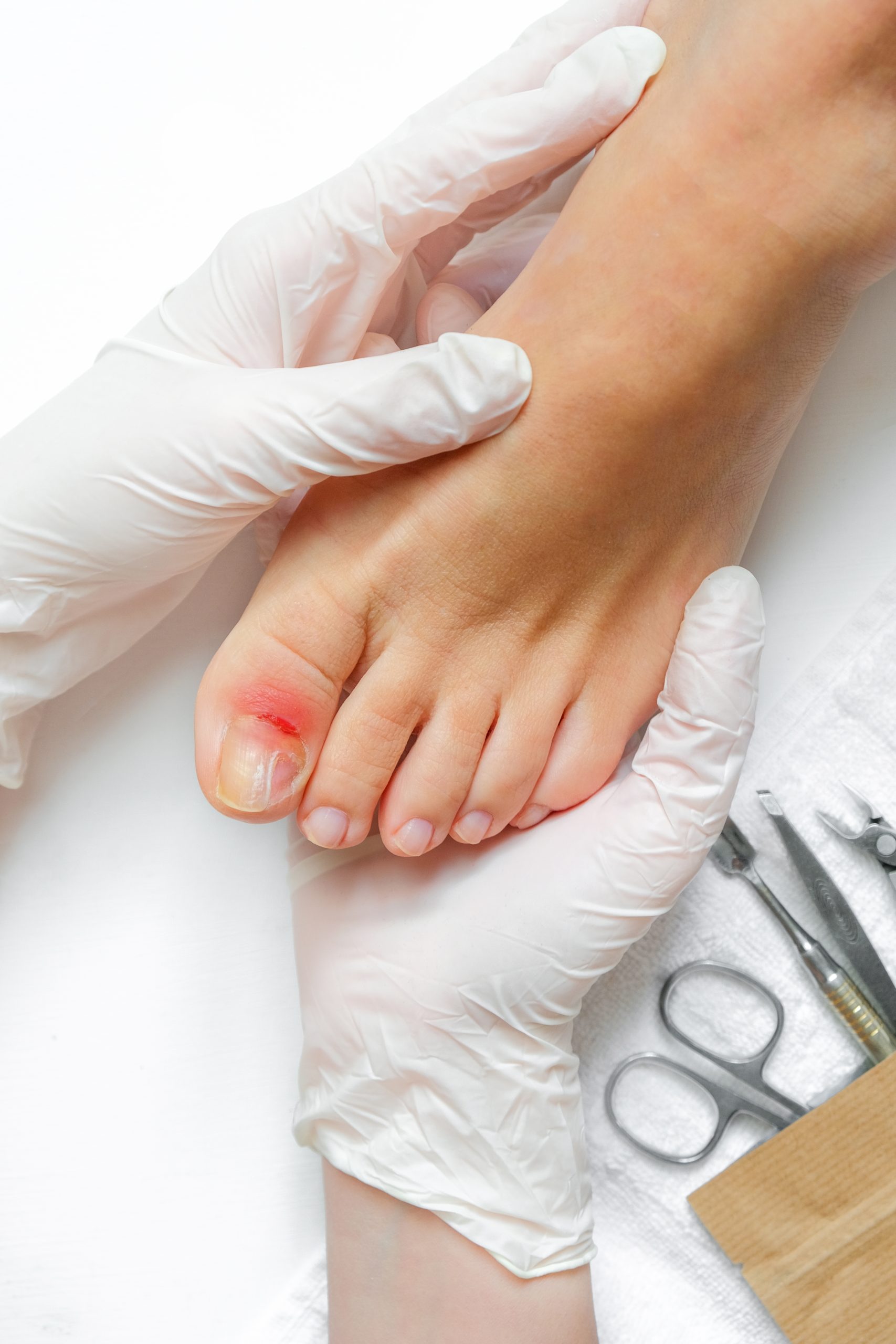
You found something on your foot. A sore that was not there last week, a blister that has not closed, a callus that has changed colour, a patch of skin that looks wrong. And the thing that is making you hesitate is that it does not hurt much, or at all. So it is probably fine, and you will keep an eye on it.
That instinct is completely understandable and it is the wrong one here. Diabetic foot wound care works differently from the rest of foot care for one specific reason, and once you understand that reason the urgency stops feeling like a sales pitch and starts making sense.
Table of Contents
- Why diabetic foot wound care works differently
- What should prompt a call today
- What a wound check actually involves, and who does what
- Why waiting is the risk, not the visit
- What happens after the first visit
- Frequently Asked Questions
- Getting seen quickly in Alexandria and Loudoun
Why diabetic foot wound care works differently
Diabetes can damage the small nerves in the feet over time, a condition called peripheral neuropathy. When that happens, the signal you normally rely on to tell you something is wrong gets quieter or disappears. A wound that would have you limping and calling someone within the hour instead sits there feeling like nothing at all.
The Centers for Disease Control and Prevention makes this point plainly in its guidance for people with diabetes: nerve damage can mean you do not feel a cut, a blister or a sore, which is why daily visual inspection is recommended rather than waiting to feel a problem. Pain is normally the alarm system. Neuropathy turns the alarm down.
There is a second factor. Diabetes can also affect circulation to the feet, and tissue with reduced blood supply has a harder job repairing itself and fighting off bacteria. So you can have a wound you cannot feel, on tissue that is slower to heal, in a part of the body that spends all day inside a shoe under load. Those three things together are the whole reason diabetic foot wounds are treated with more urgency than their appearance usually suggests.
None of that means something bad is definitely happening to you. It means the usual way of judging seriousness, how much it hurts, is not reliable here, so the judgement has to be made by someone looking at it.
What should prompt a call today
Call the office rather than waiting if you have diabetes and you notice any of the following:
- Any new break in the skin on your foot: a sore, a blister, a crack, a cut, however small.
- A callus that has darkened, softened, started to weep, or developed a spot in the middle of it.
- Redness spreading outward from any spot on your foot.
- Warmth, swelling, or an area that feels hotter than the same place on the other foot.
- Any drainage, odour, or discolouration.
- New numbness, tingling or burning, or a change in how much you can feel.
- A wound of any size that has not closed.
- A fever, or feeling generally unwell, alongside anything on your foot.
That list is not a diagnosis and it is not a ranking. It is a list of reasons to have a clinician look, because the difference between a minor thing and a serious one on a diabetic foot is frequently not visible to the person it belongs to.
If any of that describes what you are looking at, call the office at 703-832-9013 for a prompt evaluation rather than booking a routine slot several weeks out.
What a wound check actually involves, and who does what
The reason people delay is often not denial. It is not knowing what they are walking into. So here is the honest version.
What the clinician does. A diabetic foot exam is a defined clinical procedure rather than a glance. MedlinePlus, the patient-information service of the National Library of Medicine, describes what it generally covers: an inspection of the skin and nails, a check of pulses and circulation in the foot, and testing of sensation, usually with a thin nylon filament pressed against different points to map where feeling is intact and where it is reduced. If there is a wound, it is measured, its depth is assessed, and the surrounding tissue is examined. Imaging may be ordered if there is any concern the wound involves deeper structures or bone. A sample may be taken if infection is suspected.
If the wound needs cleaning or dead tissue removed, that is debridement, and it is performed by a clinician in the office. If pressure needs to be taken off the wound so it is not being reloaded every time you stand up, that is offloading, and it is arranged with specific footwear, padding or casting that is fitted for you. Dressings are selected for the particular wound and changed on a schedule the clinician sets.
What your job is. This is the part that matters most, so it is worth being blunt: dressing, cleaning and debriding a diabetic foot wound are not home tasks. They are clinician-performed steps, and attempting them yourself is how a manageable wound becomes a complicated one. Your role between visits is different and just as important. Look at your feet every day, including the soles and between the toes, using a mirror or asking someone if you cannot see them easily. Follow the dressing and offloading instructions you were given exactly, including the parts about how much walking you should be doing. And report any change promptly rather than waiting for the next scheduled visit.
If you were given footwear or a device to keep weight off the wound, wear it. Offloading is frequently the step patients quietly skip because it is inconvenient, and it is one of the steps that matters most.
Why waiting is the risk, not the visit
People put off the call because the visit feels like the thing that might turn a small problem into a big one. It is the other way round.
A wound on a diabetic foot is being reloaded with every step, in a warm enclosed environment, on tissue that may have a reduced blood supply, in a person whose ability to feel a change is diminished. Time is not neutral in that situation. The Mayo Clinic guidance on diabetes and foot care makes the same basic point that every clinician in this field would: small problems on a diabetic foot are worth treating as though they matter, because the early window is when the options are simplest.
What that does not mean is that anything dramatic is likely for you. Most diabetic foot problems seen early are managed with straightforward in-office care. Nobody is going to catastrophise your foot to get you in the door, and nobody can tell you from a description what you actually have. The honest statement is narrower and more useful than either extreme: the sooner it is looked at, the more options tend to be available, and the less any single decision has to carry.
You can read more on the practice diabetic foot ulcer page and on limb salvage and wound care, which cover the treatment side in more detail than this article does. If the wound you are dealing with is on the lower leg rather than the foot and you do not have diabetes, chronic venous leg ulcers are a related but distinct problem.
What happens after the first visit
Wound care is a course rather than an appointment. Expect to be seen again, often at short intervals at first, so the wound can be measured and the plan adjusted as it changes. Dressings get changed on a schedule. Offloading gets reassessed. If circulation is a concern, you may be referred for vascular assessment, and if infection is involved, antibiotics and closer monitoring come into it.
How long any of this takes varies a great deal from person to person. It depends on the wound, on circulation, on blood sugar control, on how much time you spend on your feet, and on other health conditions. A clinician who gives you a range and explains what it depends on is being accurate. Anyone who gives you a firm date is not.
Call 703-832-9013 for a prompt evaluation, or contact the office if you would rather start with a message.
Frequently Asked Questions About Diabetic Foot Wound Care
When should I see a podiatrist about a diabetic foot wound?
Promptly, and for any new break in the skin, however small it looks. Because diabetes can reduce sensation in the feet, how much a wound hurts is not a reliable guide to how serious it is. Redness spreading outward, warmth, swelling, drainage, odour, or fever alongside a foot problem are all reasons to call the same day rather than book a routine appointment.
Can I treat a diabetic foot wound at home?
No. Cleaning, dressing and debriding a diabetic wound are clinician-performed steps, not home tasks, and doing them yourself can make a manageable wound worse. Your role between visits is to inspect your feet daily, follow the dressing and offloading instructions you were given exactly, and report any change promptly rather than waiting.
Why does my diabetic foot sore not hurt?
Diabetes can damage the small nerves in the feet over time, which is called peripheral neuropathy. When that happens, the pain signal that would normally tell you something is wrong is reduced or absent. This is precisely why daily visual inspection is recommended for people with diabetes, and why a wound you cannot feel should be taken as seriously as one that hurts.
What does a diabetic foot exam involve?
Generally an inspection of the skin and nails, a check of the pulses and circulation in the foot, and sensation testing, often using a thin filament pressed at various points to map where feeling is intact. If there is a wound, it is measured and assessed for depth, and imaging or a sample may be taken if there is concern about deeper involvement or infection.
How often should someone with diabetes have their feet checked?
Check your own feet daily, including the soles and between the toes. Professional foot examination intervals vary depending on whether you have neuropathy, circulation problems, a history of ulcers, or foot deformity, so ask your own clinician what schedule is appropriate for you rather than assuming an annual check is sufficient.
Getting seen quickly in Alexandria and Loudoun
Both offices handle diabetic foot and wound care, and which one you choose should be about how fast you can physically get there rather than about which is nearer on a map.
The Alexandria office on Eisenhower Avenue has on-site building parking, which sounds like a small thing and is not when you are being told to stay off a foot. You are not walking several blocks from a street space in Old Town to get to an appointment about a wound you should not be loading. From the Beltway or from Route 1 it is a short, direct run.
The Leesburg office on Cornwall Street NW serves Loudoun, and Loudoun is a genuinely different problem. Patients in Ashburn, Sterling, Lansdowne and Purcellville who need to be seen at short intervals over several weeks are the people for whom the drive decides everything. A wound care course that means a trip down the Dulles corridor or into Alexandria every few days is a course people stop completing. Booking at the Leesburg office instead is frequently the difference between finishing a treatment plan and abandoning it halfway, and finishing it is the part that matters.
If you have diabetes and you have found something on your foot, call 703-832-9013 today rather than waiting to see whether it settles.
Medically reviewed by Dr. Lonny Nodelman, DPM, FACFAS, on September 14, 2026. Dr. Nodelman is Board Certified in Foot Surgery by the American Board of Foot and Ankle Surgery and a Fellow of the American College of Foot and Ankle Surgeons, and his clinical focus includes limb salvage for diabetic foot wounds and infections.
This article is general information about diabetic foot and wound care. It is not medical advice, it does not diagnose any condition, and it cannot tell you what is happening with your own foot. It does not describe home treatment for a diabetic wound, because diabetic wounds require clinician-directed care. If you have diabetes and have noticed any change to your feet, contact a licensed clinician promptly.